
Five systems, one report: when your company needs a panel, not another landing page
Łukasz Grzybowski
Founder, Aspika · QA / SDET · websites and web products
Friday, 4:30 p.m., board report due tonight. Stock in the vendor portal, sales in Excel, orders in email. Sound familiar?
See the LuncherBox Panel case study or ask about a similar project.
Friday, 4:30 p.m. The operations manager needs a report by tonight: what sold, what is running low at each location, what to order for Monday.
They log into the hardware vendor portal. Open the order template spreadsheet. Paste fragments from supplier emails. Somewhere along the way a different number appears than yesterday and nobody knows which version is current.
A company website will not fix that. It has a different job: present the offer and capture a lead. The pain starts after the sale, when operations grow and the truth about the business lives in five places at once.
Three signals this is no longer a website content problem
We most often hear these from companies that reach for a panel:
- The same weekly report takes longer every time because there is more data but the process is unchanged.
- Different people see different numbers - the vendor portal says one thing, Excel another, and the decision still happens in a meeting.
- Orders follow a template that lives in someone's head or in the fifth sheet of a workbook. One quantity mistake is a real loss, not a cosmetic issue.
If any of these sounds familiar, another services page will not help. You need one workspace for the operations team.
Before and after: how daily work changes
Before: the operator logs into several systems, copies numbers, searches email for who approved the last order. The management report is built at the last minute. Trust in the numbers is low because everyone has their own version of the truth.
After a panel: the same team sees stock and sales synced from the vendor system, places orders from templates in one place, keeps an archive of decisions and roles - who can approve, who can only view. The report is not a collage from five sources. It follows from data already in the system.
The panel does not replace the manufacturer system or the wholesaler. It connects them to your process as if they had always been one tool.
LuncherBox: one example from practice
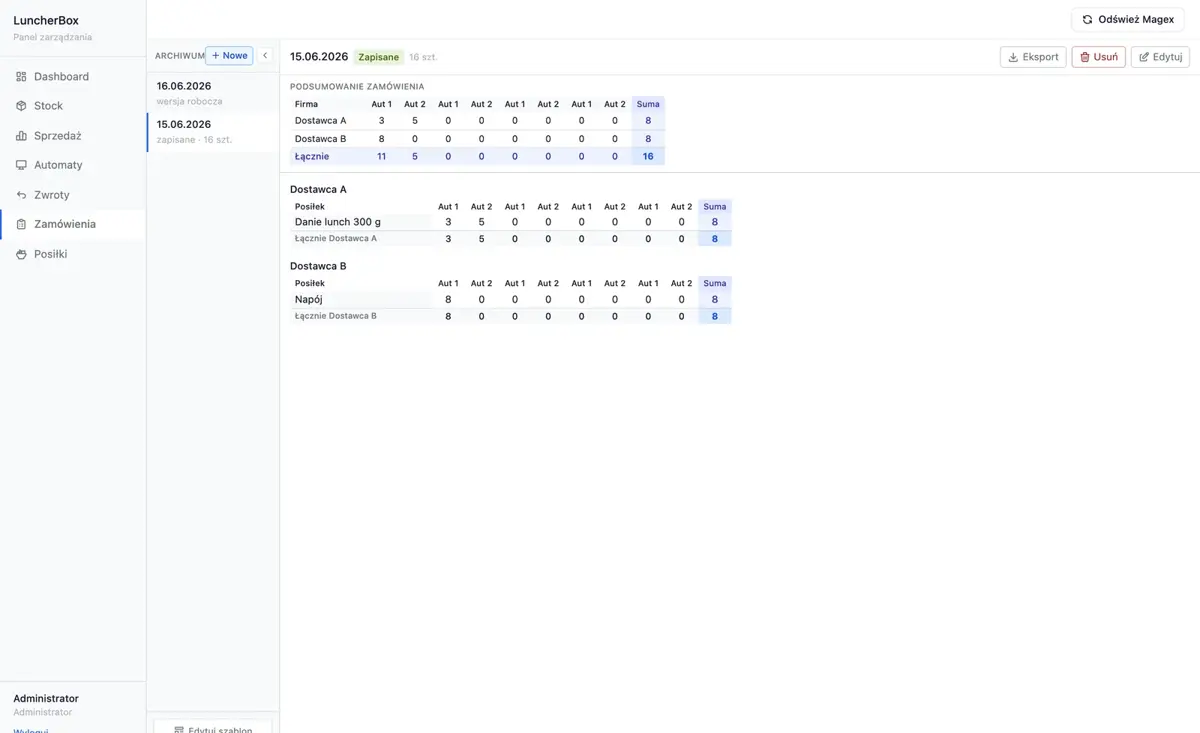
In the LuncherBox Panel project we built a panel for a vending fleet operator. The team needed one screen for daily work: day summary, stock and sales from an external system, their own orders module to suppliers with templates and archive.
It was not another website. It was the answer to: how do we stop losing Fridays to a report nobody fully trusts.
For integration with the vendor API see Data lives in the vendor system. Your order process does not. For safe rollout without touching production see Rolling out a panel without risking production data.
Four questions before talking to a software partner
Before you look for a vendor, answer honestly:
- How many hours per week does the team spend manually assembling reports or summaries?
- Do you have a repeatable process (orders, replenishment, approvals) that today lives outside a single system?
- Should different roles (manager, operator, admin) see the same picture with different permissions?
- Does operational data already exist with a supplier or partner, but you lack your own decision layer and archive?
If more than one answer is yes, a panel is a real alternative to another spreadsheet - not for every company right away, but for the one that feels that Friday report on its own skin.
Summary
A company website builds brand and leads. An operations panel organises work when operations outgrow the tools used to run them.
If your team assembles a weekly report from several systems and nobody is sure of the numbers until the last moment, that is not a marketing problem. It is a signal to talk about a panel.
Frequently asked questions
- How is an operations panel different from a company website?
- A website sells and builds trust with new customers. A panel helps the team that already runs the business: stock, orders, reports. It is an operations tool, not a brochure.
- Does every company need a panel?
- No. A panel makes sense when you have a repeatable process, several data sources, and lose time every week piecing together the picture manually. If one system and one spreadsheet are enough, they usually are.
- Does it have to be a native mobile app?
- Not at the start. A responsive browser panel is often enough when the team works on laptops or tablets in the office or in the field.
- How do you judge if the project is worth it?
- Count weekly hours on manual reports, order mistakes, and the cost of decisions delayed by a week. If it is not a one-off problem, a panel usually pays off faster than another landing page.
Have a similar topic in your project?
Send a short description. We will suggest next steps.
Related articles
Aspika
Aspika is Łukasz Grzybowski's studio. Websites and web products with an engineering approach to quality.
About →